By Tunji Ajayi | Whyte Cleon Limited | 6 min read
The importance of work-life balance HR strategies has become one of the defining conversations in modern HR practice. With the rapid rise of remote working, flexible scheduling, and an increasingly urgent emphasis on employee wellbeing, HR professionals are navigating both new challenges and significant opportunities. The organisations that get this right will attract stronger candidates, retain them longer, and build cultures that sustain performance over time.
Work-life balance has moved from a perk to a strategic priority. Here are six practical, evidence-based strategies for building genuine work-life balance into the fabric of your organisation.
These strategies sit alongside a broader wellbeing agenda — see our article on boosting employee wellness and preventing burnout for a complementary approach.
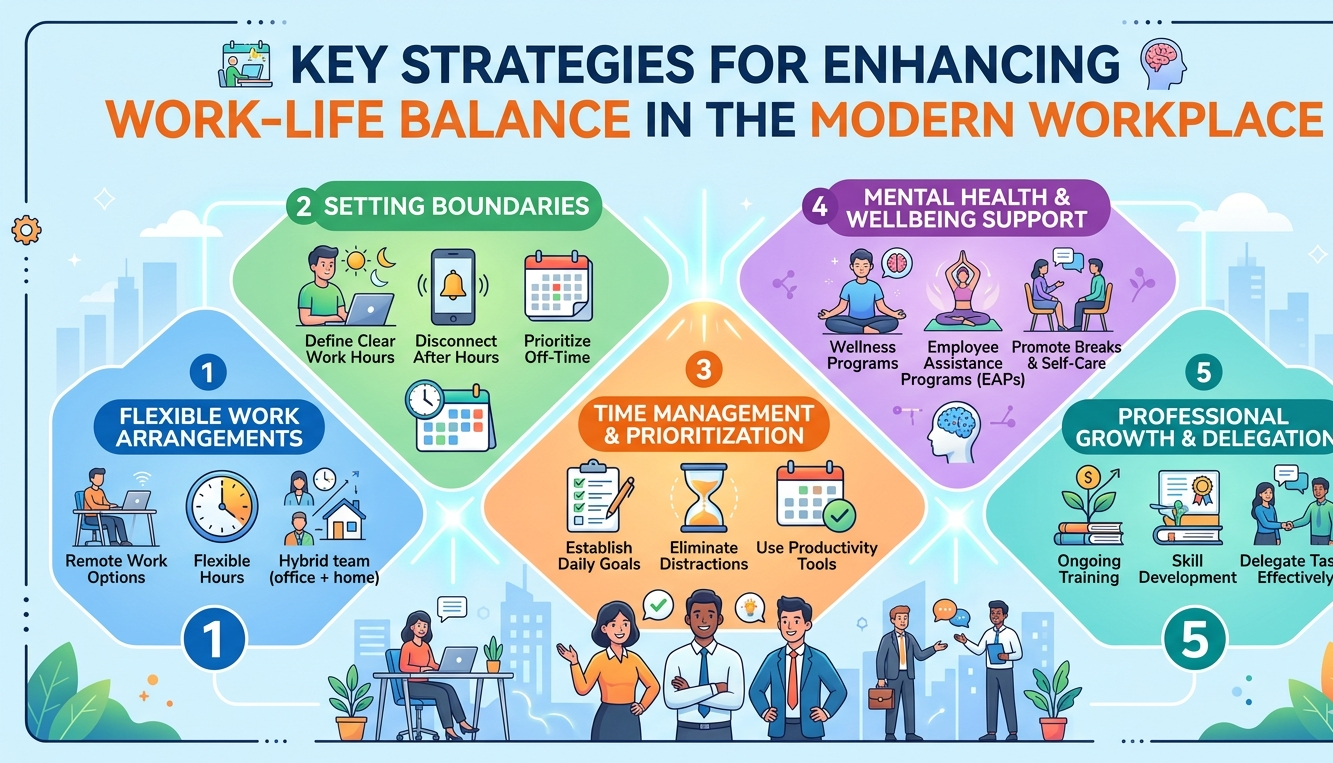
1. Flexible Work Arrangements
Many leading organisations are adopting hybrid working models that give employees meaningful choice over where and when they work. This flexibility fosters autonomy and enables individuals to manage professional responsibilities alongside personal obligations — contributing directly to higher job satisfaction, reduced absenteeism, and stronger overall productivity. Flexibility is not just a wellbeing initiative. It is a talent retention strategy.
2. Accessible Mental Health Support
HR departments are increasingly recognising that mental health is inseparable from sustainable performance. Providing access to counselling services, wellness initiatives, and designated mental health days equips employees to manage stress proactively rather than reactively. Building these resources into standard benefit packages — not as emergency measures but as normalised support structures — reduces stigma and increases utilisation.
3. Smart, Purposeful Use of Technology
When used effectively, technology enhances rather than erodes work-life balance. Collaborative platforms and project management tools like Asana, Notion, and Trello streamline communication, reduce time spent on low-value tasks, and give employees greater control over their working day. The goal is to use technology to free up time and reduce friction — not to enable perpetual connectivity.
4. Building a Culture That Genuinely Values Balance
Policies mean very little if the culture they sit within signals something different. As part of effective work-life balance HR strategies, leaders must actively encourage managers to model healthy boundaries — respecting non-working hours, taking their own time off, and publicly championing rest as a performance strategy. When senior leaders live these values, they establish norms that cascade through the entire organisation.
5. Training and Development in Personal Effectiveness
Training programmes focused on time management, task prioritisation, and assertive communication equip employees with the practical skills they need to manage their workloads sustainably. Empowering people to set boundaries and say no to non-essential demands is one of the most effective and underutilised approaches to improving work-life balance at an individual level.
6. Continuous Feedback and Iterative Improvement
Establishing regular feedback mechanisms — including employee surveys, pulse checks, and suggestion channels — enables HR teams to track the real-world impact of work-life balance policies and adapt them as employee needs evolve. Effective wellbeing strategy is not a one-time design exercise. It is a continuous loop of listening, responding, and refining.
Challenges in Achieving Sustainable Work-Life Balance
Despite growing awareness, genuine barriers remain. The expectation of constant connectivity — driven by mobile technology and always-on communication norms — makes it difficult for employees to truly switch off. In some organisations, a deeply embedded culture of overwork continues to signal that output matters more than people. Addressing these challenges requires both structural intervention and sustained cultural leadership. Policies change behaviour; leadership changes culture.
Work-life balance is a cornerstone of successful HR practice and long-term organisational health. For organisations committed to attracting and retaining the best talent, it is not optional — it is essential. The workplaces that will win in 2025 and beyond are those that treat employee wellbeing not as an HR initiative, but as a business strategy.
If you are designing or redesigning your work model, read our blueprint on balancing remote, hybrid, and onsite work for organisational resilience.
References
- CIPD. Flexible Working Practices.
- Mental Health Foundation UK. Workplace Mental Health Resources.
- ACAS. Promoting Work-Life Balance.
- Office for National Statistics (ONS). Employee Wellbeing in the UK Labour Market.
- World Health Organization. Mental Health in the Workplace.
Frequently Asked Questions
What are work-life balance HR strategies?
Work-life balance HR strategies are policies, programmes, and workplace practices designed to help employees effectively manage their professional responsibilities while maintaining their personal wellbeing. These strategies support employee satisfaction, productivity, and retention.
Why is work-life balance important in the workplace?
Work-life balance helps reduce stress, prevent burnout, improve mental health, and increase employee engagement. Organisations that promote balance often experience higher productivity and stronger employee retention.
How can HR improve work-life balance for employees?
HR can improve work-life balance by offering flexible work arrangements, providing mental health support, encouraging time off, implementing wellbeing programmes, and creating a culture that respects personal boundaries.
What role does flexible working play in work-life balance?
Flexible working allows employees to better manage their schedules, family commitments, and personal responsibilities. This flexibility often leads to increased job satisfaction, improved wellbeing, and stronger organisational commitment.
How does technology support work-life balance?
Technology can support work-life balance by streamlining communication, automating repetitive tasks, improving collaboration, and helping employees manage workloads more efficiently. However, organisations should also establish boundaries to prevent constant connectivity.
What are the biggest challenges to achieving work-life balance?
Common challenges include excessive workloads, unrealistic expectations, always-on communication, poor time management, and organisational cultures that reward overwork rather than sustainable performance.
How does work-life balance affect employee retention?
Employees who maintain a healthy work-life balance are generally more satisfied, engaged, and loyal to their employers. Effective work-life balance strategies can reduce turnover and strengthen an organisation’s employer brand.